Its been over 3 years since I’ve fallen in love with space, stars, galaxies and everything thats out there.
Open my YouTube homepage and you’ll know me instantly. Well, that applies to everybody and mine is all space documentaries, black hole explainers, and hour-long interviews with people like Brian Cox. Netflix figured me out too, its algorithm gave up suggesting anything else and now just hands me space films and cosmos series on repeat. I’m not complaining. If anything, I want to explain why this happened to me, because once you start looking up, it’s very hard to stop.
It Starts With the Numbers
Space ruined my sense of scale, and I love this amusement.
Light travels at about 300,000 kilometers per second. At that speed, sunlight still takes 8 minutes and 20 seconds to reach us — meaning every sunrise you’ve ever watched is old news. Years ago when I learnt that the nearest star system, Alpha Centauri, is about 4.37 light-years away, I am sure I didn’t even flinch. But as I started having a sense (however rudimentary it is) of it my ability to comprehend has only grown. That distance(4.37 light-years) could sound close until you convert it: roughly 41 trillion kilometers. If you boarded the fastest spacecraft humans have ever built, you’d still need tens of thousands of years to get there.
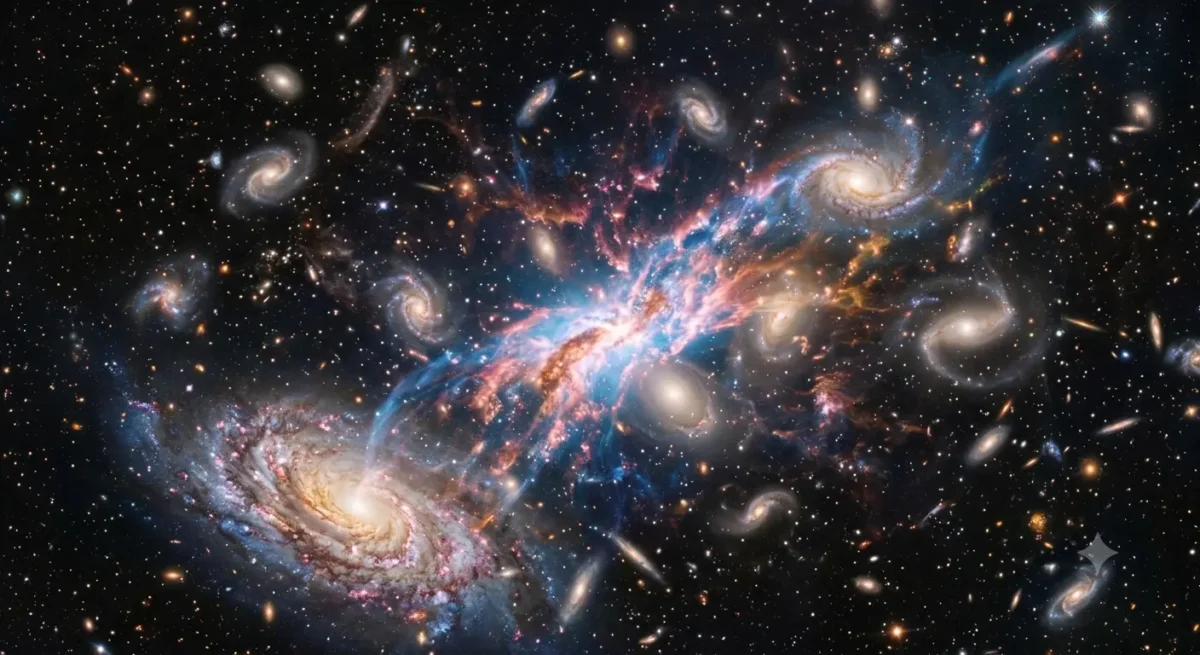
And that’s just next door. Our Milky Way holds an estimated 100 to 400 billion stars and stretches about 100,000 light-years across. The observable universe? Around 93 billion light-years wide, containing something like two trillion galaxies. Two trillion. And here’s the part that keeps me awake: that’s only the observable universe – the bubble of space whose light has had time to reach us – meaning as a human thats how far we can see. Beyond that edge, there is more. How much more? Nobody knows. Possibly infinitely more. We are, quite literally, looking at the universe through a keyhole, and even the keyhole view is beyond comprehension.
Black Holes: Where Physics Gives Up
If numbers hooked me, black holes are what made it an obsession.
A black hole is a region where gravity is so extreme that not even light — the fastest thing in existence — can escape. Cross the event horizon and there is no coming back.
Now what is ‘Event Horizon’?
I am nobody to explain but I just visualize a black hole and think of its edge, that edge is somehow where the pull of the gravity is so high that not even light could escape. It just dissapears. They call it the ‘Point of no Return’.
Wait, there is more. There is something called ‘Singularity’. Singularity is the very core of a black hole – a point where our equations simply stop working. Physics, humanity’s best toolkit for understanding reality, shrugs.
The supermassive black hole at the center of our own galaxy, Sagittarius A*, weighs about 4 million times the mass of our Sun. Others are far bigger — some monsters exceed billions of solar masses. And black holes don’t just swallow things; they warp time itself. Sit near one, and time genuinely passes more slowly for you than for someone far away. That’s not science fiction. That’s Einstein’s general relativity, verified over and over.
Interstellar Made It Personal
This is why Interstellar isn’t just a movie to me — it’s the film that stays lodged in my chest years later. It explained all the ‘fancy’ terms that would otherwise mean “just some space stuff” that most people don’t bother digging in. When Cooper and Brand land on Miller’s planet, orbiting the black hole Gargantua, every hour they spend costs seven years back on Earth. And that mechanic isn’t a screenwriter’s invention; it’s time dilation, real physics, calculated with help from a Nobel laureate named Kip Thorne. When Cooper returns to find decades of his daughter’s video messages waiting for him, the science and the heartbreak collapse into one moment. That scene teaches something no textbook ever could: the universe’s strangest laws aren’t abstract. They would act on us in the form of our relationships, our time with the people we love. That’s when space stopped being trivia for me and became something almost spiritual.
Two Messages in a Bottle
Then there are the Voyagers, maybe the most romantic thing our species has ever done.
Two flying objects launced and expected never to return but keep sending information back to earth and they are doing it for decades.
Launched in 1977, Voyager 1 and Voyager 2 flew past the outer planets, sent home our first close-up portraits of Jupiter’s storms and Saturn’s rings, and then just… kept going. Voyager 1 is now more than 24 billion kilometers away — the farthest human-made object in existence — traveling through interstellar space, beyond the Sun’s protective bubble. Its signal, moving at light speed, takes over 22 hours to reach us.
Each spacecraft carries a Golden Record: greetings in dozens of languages, the sound of rain, a heartbeat, music from Bach to Chuck Berry. It’s a message in a bottle thrown into a cosmic ocean, on the astronomically small chance that someone, someday, finds it. Long after their power fades in the coming years, both Voyagers will drift silently among the stars for billions of years — likely outlasting Earth itself. A piece of us, out there, forever. How can you not be moved by that?
Why You Should Look Up Too
I share all this because I think fascination with space isn’t a niche hobby, it’s the most natural human reaction once you actually confront what’s above us. Every atom of iron in your blood was forged inside a dying star. You are not just in the universe; you are the universe, briefly organized into something that can wonder about itself.
So tonight if the sky is clear, step outside and find one star. The light hitting your eye may have left that star before you were born, you’re looking directly into the past. Then queue up one documentary, or one Brian Cox interview, or watch Interstellar again with the physics in mind. I promise the rabbit hole is deeper and more beautiful than you expect.
The universe is under no freaking obligation to make sense to us. But it lets us try anyway and to me, that’s the greatest adventure there is.