I got into this industry in 2014, back when “content is king” was still a fancy phrase (ps: content is still the king might not be fancy but indispensable). I’ve spent the years since bouncing between blogs in wildly different niches, running WordPress sites like my life depended on it (some months it kind of did), and watching Google blow up the rulebook roughly every quarter. Somewhere along the way I picked up a genuine addiction to Ahrefs, an unhealthy occasional relationship with SimilarWeb, and enough scar tissue from algorithm updates to write a memoir. But ended up with this.
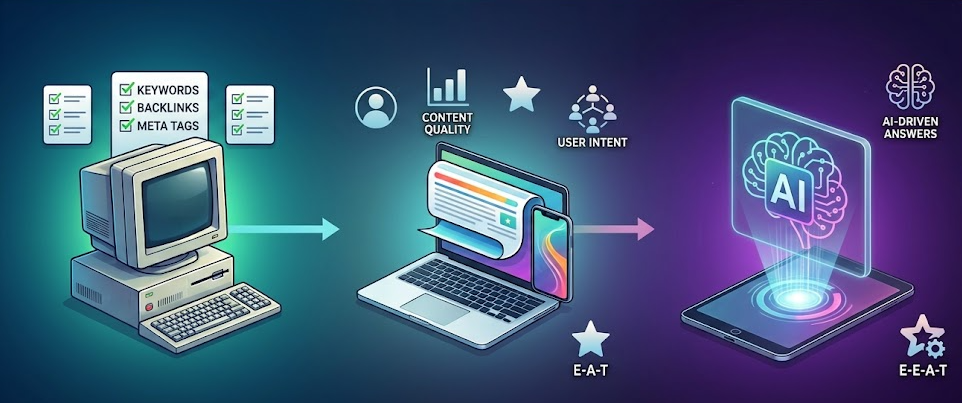
2014: Learning The Chaos around Digital Content
If you were doing SEO in 2014, you remember it as the year Google decided not to play nice anymore. Panda 4.1 came through and flattened thin content sites like a truck through a street food vendor. Lyric sites, content farms and anyone publishing 400-word fluff pieces just to rank got wrecked. Then Penguin 3.0 showed up to remind everyone that buying a hundred spammy backlinks from a “link farm” in a country you couldn’t find on a map was, in fact, a terrible idea. By December, Google announced Penguin would update continuously instead of in big scary batches, which was basically Google saying “we’re always watching now, so behave.”
Back then, my job was refreshingly blunt: write good stuff, get some backlinks, don’t keyword-stuff like it’s 2009, and you’d probably rank. Meta descriptions still mattered. Exact-match domains were dying but not dead. And “mobile-friendly” was a nice-to-have, not a survival requirement that too until the scary ass Mobilegeddon landed in 2015 and made “responsive design” the two words every agency owner started screaming into the void.
Oh that seems like ages ago. I actually had to do some fact checks for this.
The Middle Years: Google Gets a Brain
Then things got weird, in the best and worst ways. RankBrain rolled in and suddenly Google wasn’t just matching keywords, it was trying to understand the intent, which was good for us. Hummingbird had already nudged things toward natural language, but RankBrain was the moment machine learning quietly took the wheel. BERT followed a few years later and basically taught Google to read prepositions correctly, which sounds small until you realize it upended how you had to think about phrasing.
This is also when E-A-T (Expertise, Authoritativeness, Trustworthiness) became the phrase every content manager had tattooed on their brain, and eventually grew an extra E for “Experience” because apparently three letters weren’t dramatic enough. Suddenly it wasn’t enough to just write well, you had to prove a human with actual credentials wrote it, and that Google trusted your site as a whole, not just the one page trying to rank. Core updates became a monthly weather forecast. You didn’t ask “did we get hit,” you asked “how bad.”
I spent those years elbow-deep in WordPress, and if there’s one thing seven years of managing content in that ecosystem teaches you, it’s that plugins will betray you the moment you trust them completely, and Yoast’s green traffic light means significantly less than it wants you to believe.
2026: The Ground Actually Moved
Here’s where it gets genuinely wild, and where I think a lot of SEOs are quietly panicking behind confident LinkedIn posts. As of early 2026, AI Overviews are showing up on roughly 48% of all searches, up from about a third just a few months earlier, and on informational queries that number blows past 70%. Click-through rates on the number one organic spot have dropped from around 32% to 23% when an AI Overview sits above it. Zero-click search isn’t a scary theory anymore, it’s just Tuesday.
There is a big BUT here… and this is the part that keeps me from fully spiraling. Visitors who do click through from an AI Overview convert at a wildly higher rate than average traffic. And sites that actually get cited inside those AI answers see a real traffic bump. So the game hasn’t ended, it’s changed shape. Ranking #1 used to be the whole ballgame. Now getting cited by the AI is its own ballgame, played on a different field, with different rules, and honestly nobody has fully written the playbook yet.
This is where “Generative Engine Optimization” (GEO) crashed the party. Now you need optimizing not just for Google’s ten blue links but for how ChatGPT, Perplexity, Gemini, and AI Overviews summarize and cite your content. Ahrefs now tracks brand visibility across half a dozen AI platforms with its Brand Radar tool. Semrush rebuilt itself around this with Semrush One, monitoring how often your brand gets mentioned inside AI answers. If you’re not tracking AI mentions alongside rankings in 2026, you’re basically driving while only checking your rearview mirror.
And Social Never Stopped Mattering
Somewhere in the middle of all this SEO chaos, I also became the person managing social calendars, because content managers apparently get to wear every hat in the closet. Tools like Hootsuite, Buffer, and Sprout Social have quietly turned into AI co-pilots. They now schedule posts around AI-predicted engagement windows instead of your gut feeling about “lunchtime is good, right?”
Teams using that AI scheduling are reportedly seeing engagement bumps of 25 to 40% over fixed posting times, which honestly checks out with what I’ve seen.
Twelve years in, the constant hasn’t been any single tactic, keywords, backlinks, E-A-T, whatever comes next, it’s been the pace of change itself. The SEOs who’ve survived aren’t the ones who mastered one system. They’re the ones who’ve understood the core concepts, adapted the changing parameters, accepted that the system is temporary, stayed curious, and kept their tool stack (and their sanity) flexible enough to pivot when Google or now, an AI model none of us fully control decides to move the goalposts again. Which, if the last twelve years are any indication, it will. Probably next Tuesday 🙂
Great content! Keep up the good work!